Missouri's rules on NP clinicals and who can precept you
Missouri's nursing rules say a great deal about how a nurse practitioner earns prescribing authority and almost nothing about students. No Missouri Board rule was found that decides who may precept an APRN student, so Maryville's own preceptor rule is the gate. Missouri's definition of a "qualified preceptor" still matters if you plan to prescribe controlled substances in Missouri after you graduate.
Looking for a preceptor in Missouri?
Tell us your track, term and area. A placement advisor replies about preceptors who fit Maryville's rule and Missouri's definition.
Missouri's APRN rule, and what it leaves out
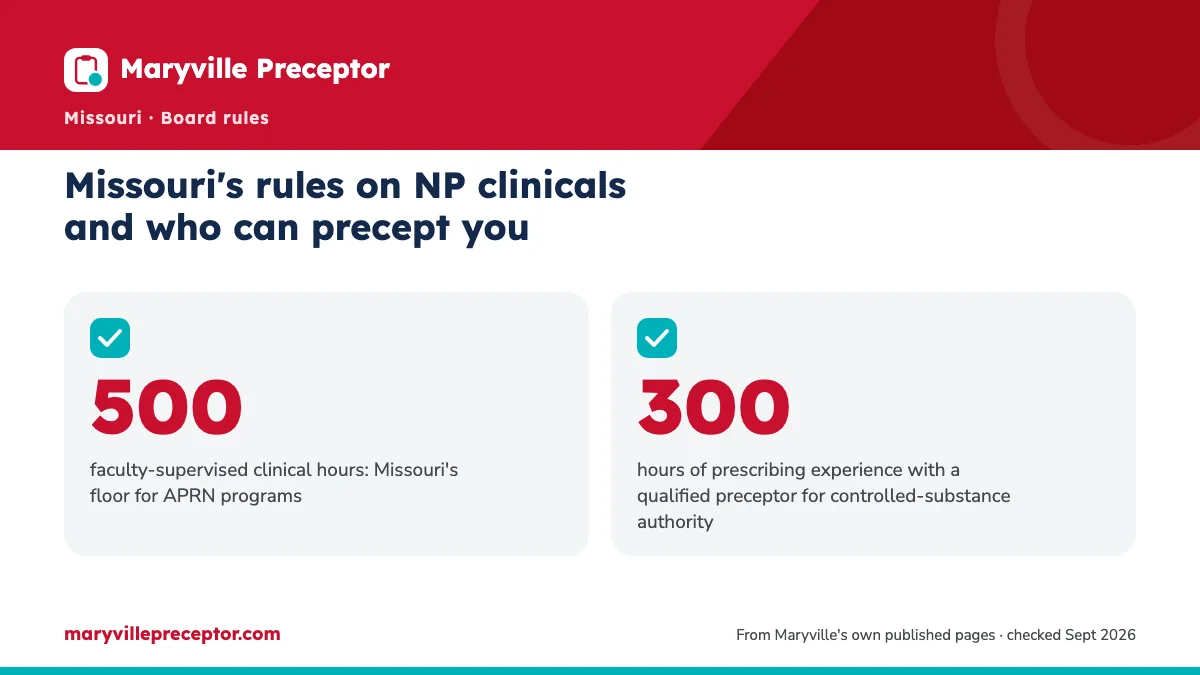
The Missouri State Board of Nursing sets its APRN requirements in 20 CSR 2200-4.100, in effect since May 30, 2024. For education, the rule asks an APRN program to provide at least 500 faculty-supervised clinical hours, a floor in place since January 1, 2009. Maryville's current curriculum sits above it: since Spring 2024, each NP concentration has required 750 clinical hours.
Research found no Missouri Board rule that governs APRN student placements, whether the school is in Missouri or elsewhere, and none that caps how many APRN students one preceptor may supervise. Neither the APRN rule nor the collaborative practice rule mentions students at all.
So the Board is not the one approving your preceptor or site; Maryville and the facility are. The Board's definitions matter in a narrower place: the prescribing record you may need later.
What Missouri calls a qualified preceptor
The same rule gives "qualified preceptor" a specific meaning tied to prescribing. Under 20 CSR 2200-4.100, a qualified preceptor is one of two people:
- an APRN with a current, unrestricted RN and APRN license, whose scope includes prescribing and who has met the requirements for prescriptive authority;
- a licensed MD or DO with unrestricted prescriptive authority.
Physician assistants are not in that definition. The rule also defines "preceptorial experience" as a designated part of a formal education program, carried out in a healthcare setting and involving direct patient care or client management. A clinical practicum inside a formal NP program is the plain example, which is why the identity and license of the person supervising your prescribing matter under this rule.
Why the definition matters: controlled-substance authority
The definition does its work in section (3) of the rule, which covers authority to prescribe controlled substances. A Missouri APRN seeking that authority needs:
- a Board form documenting 300 or more clock hours of preceptorial experience, with a qualified preceptor, in prescribing drugs, medicines and therapeutic devices;
- an advanced pharmacology course;
- 1,000 post-graduation hours of APRN practice;
- that authority delegated in a collaborative practice arrangement.
Read together, the definition and section (3) suggest that prescribing hours logged under a physician assistant would not count toward the 300. That is an inference from the rule text, not a Board ruling, and the same reasoning applies to hours with a clinician who does not prescribe.
If you expect to practice in Missouri, keep your own record of who supervised your prescribing hours and what license they held, and get the current documentation form from the Missouri State Board of Nursing.
A preceptor Maryville accepts is not automatically a Missouri qualified preceptor. The 300 prescribing hours need one.
Collaborative practice: the arrangement behind every Missouri NP
Missouri is a restricted-practice state in the AANP's classification. Every NP there practices, for their entire career, under a collaborative practice arrangement (CPA) with a physician, and the arrangement limits ratios, sets chart review and restricts controlled substances. A Missouri NP preceptor therefore brings a physician relationship into your rotation.
The main terms are in 20 CSR 2200-4.200, the Board of Nursing's CPA rule, effective July 30, 2024:
- A CPA can be written agreements, protocols both parties agree on, or standing orders.
- The collaborating physician must be available for consultation at all times, in person or by telecommunication.
- When the APRN is diagnosing and beginning treatment of patients who are acutely or chronically ill, the physician has to be physically present at least every two weeks and review no less than 10% of the APRN's services, or 20% where controlled substances are involved.
- The APRN can be delegated authority to prescribe Schedule II hydrocodone and Schedules III–V.
A companion rule from the Board of Registration for the Healing Arts, 20 CSR 2150-5.100, requires the collaborating physician to report each CPA to that board within 30 days of any change and at every license renewal.
What the statute adds, and what to confirm
The collaborative practice statute is RSMo 334.104. Its page on the Missouri Revisor's site could not be loaded during research, so the points below come from search-result excerpts and third-party summaries. Treat them as leads to confirm at revisor.mo.gov, not settled text.
- One physician's collaborations are capped at six full-time-equivalent APRNs, physician assistants and assistant physicians in total (search excerpt of the Revisor page).
- Before an APRN practices where the physician is not continuously present, the physician must document at least a one-month period in which the APRN practiced with the physician continuously present (excerpts of Justia's 2011–2024 versions, which agree).
- A third-party 2026 guide says the old 75-mile proximity limit was removed in 2024, leaving a standard that the physician must not be so far away that collaboration is impeded.
None of these limits mentions students. They shape your preceptor's own practice, such as how many clinicians their physician already works with.
Who can precept a Maryville student in Missouri
Maryville's rule decides whether your Exxat request can be approved. Missouri's definition only bears on the prescribing record you may need later. Here they are side by side.
| Preceptor | Maryville's rule | Missouri "qualified preceptor" |
|---|---|---|
| NP, board certified, 1+ year, with prescriptive authority | Qualifies | Yes, with unrestricted RN and APRN licenses and prescriptive-authority requirements met |
| MD or DO, board certified, 1+ year | Qualifies | Yes, with unrestricted prescriptive authority |
| APRN, MD or DO not board certified | Only with an approved Preceptor Exception Form | Turns on license and prescribing authority, not certification |
| Physician assistant | "don't typically qualify" (2026 blog) | Not in the definition |
| LCSW, PsychD or PhD in Psychology | PMHNP students only | Not in the definition |
A board-certified NP, MD or DO with a year in practice and prescribing authority meets both. Maryville's exclusions still sit on top: no relatives, no one in your reporting line, no direct work colleague and not your own healthcare provider. The full rule set is on Maryville preceptor requirements, and the route for an uncertified preceptor is the Preceptor Exception Form.
PMHNP students should plan the split. Maryville's 2026 guidance opens PMHNP precepting to LCSWs and to psychologists with a PsychD or PhD, but hours with them would not come from a Missouri qualified preceptor, so keep your prescribing hours with a psychiatric NP or physician. See PMHNP preceptors.
At a Missouri site: the CPA, the contract and your license
Two practical points follow, both inferences from the rules rather than stated policy. You work inside your preceptor's CPA protocols, because the NP you train with practices under them. And extra conditions such as orientation, screening or ID badges come from the facility and its contract with Maryville, not from the Board.
Maryville's side of that contract is its MOU or the site's own agreement, and the site is judged separately from the preceptor; see site approval. Health systems with their own onboarding go through the Onboarding Request Form.
Your RN license, under Maryville's rule, must be unencumbered and valid in the state of your clinical site. For Missouri, a multistate license works: NCSBN's implementation table dates the state's compact to January 19, 2018. The state's board, compact status and major systems are summarized on the Missouri page.
Why Missouri students choose us
Missouri is Maryville's home state, and we know its rules in detail. When a placement advisor looks for a Missouri preceptor for you, the points on this page are checked before anything reaches Maryville: board certification, years in practice, prescribing authority and any tie to you. If you plan to practice in Missouri, we favor preceptors who also count as Missouri qualified preceptors, so your prescribing hours build toward controlled-substance authority. For PMHNP students, the search starts with a psychiatric prescriber.
Maryville approves every preceptor and site, and the candidates we bring it already fit its rule, and Missouri's definition where that matters to you. If a Missouri preceptor drops out mid-term, we're on call to find another. For a second pair of eyes on a candidate you've found, send us their credential and your track.
Questions Maryville students ask
Can a physician assistant precept a Maryville NP student in Missouri?
Not under Maryville's usual rule. Maryville's 2026 guidance lists PAs as not typically qualifying, and a 2023 Maryville webinar put every specialty off-limits to them. Missouri's definition of a qualified preceptor also leaves PAs out, so prescribing hours with a PA would not help toward Missouri controlled-substance authority later. Aim your search at board-certified NPs, MDs and DOs instead.
Does Missouri limit how many NP students one preceptor can take?
No such limit was found. Research into the Missouri Board's rules turned up no preceptor-to-student ratio for APRN students. The ratio that does exist is about collaboration: statute excerpts cap a physician at six full-time-equivalent APRNs, physician assistants and assistant physicians combined. A facility or Maryville may still set limits of its own.
Does Missouri's 500-hour rule mean I need fewer clinical hours?
No. The 500 faculty-supervised hours in 20 CSR 2200-4.100 are a minimum for APRN programs, and Maryville sets its own total. Maryville's NP concentrations have each required 750 clinical hours since Spring 2024, though anyone admitted in Fall 2023 or before may still follow an older curriculum. Your hour count comes from Maryville, not from the state floor.
Can a Missouri NP who just started a new job precept me?
Possibly, if they have at least a year in practice, which Maryville requires. A new job can mean a new collaborative practice arrangement, and statute excerpts say the NP must first spend at least a month practicing with the physician continuously present. That affects their schedule rather than your eligibility, so ask how their first weeks will run.
Does the Missouri Board of Nursing approve my preceptor or clinical site?
No rule found gives the Board that role for APRN students. Maryville approves your preceptor and site through Exxat, and course faculty and the site's education department sign off as well. The Board's rules matter later, if you apply for Missouri controlled-substance authority and must show prescribing hours with a qualified preceptor.
Related pages
Last checked 2026-09-23
We check these pages against Maryville's own sources. Maryville's current guides and your course faculty have the final word.
- Missouri State Board of Nursing
- Missouri Revisor of Statutes: RSMo 334.104 (collaborative practice)
- 20 CSR 2200-4.100, Advanced Practice Registered Nurse (Cornell LII copy)
- 20 CSR 2200-4.200, Collaborative Practice (Cornell LII copy)
- Maryville Nursing blog: How to Find the Right Nursing Preceptor (Feb. 2026)
Hand us the search. Keep your start date.
Tell us your Maryville track, your county and your next start. We look for a preceptor and a site that fit what Maryville approves, and help you get the Exxat request right.
- Matched to your track's population and setting
- Checked against Maryville's preceptor rules before you submit
- In person near you, or a virtual option where your course allows it
Start your placement plan
A placement advisor replies with what a Maryville-ready preceptor and site look like for you.