The Maryville MOU and affiliation agreement
Before you train at a site, Maryville and the site need a contract. Maryville's version is called the MOU (Memorandum of Understanding) or affiliation agreement; if the site has its own, that "original contract" takes its place. Your part is to find out early which one your site uses and who signs it.
Check a site before you commit
Tell us your track, term and the site you have in mind. A placement advisor replies with what to ask about its contract.
What the MOU is
Maryville's Ask Maryville article "What is the Clinical Contract" uses two names for one document: the MOU (Memorandum of Understanding) and the affiliation agreement. It is Maryville's contract with your clinical site. Maryville provides the template in the Graduate Nursing Clinical Resource Center, the login-only SharePoint site for clinical information.
That article is dated 2021, from the eValue era. The requirement itself is still live: a June 2026 article on non-compliance says attending clinicals while out of compliance breaches the site contract. So expect to need a contract, even if the steps around it have since moved into Exxat, and read the Resource Center for the current template and instructions.
Keep three things apart in your head. The contract is between institutions. Your Exxat request is about your placement. The site's onboarding is about you. Each can be finished while the others are still open, and approval of the site itself is covered on site approval.
When the site's own contract replaces the MOU
Some sites prefer their own paperwork, and Maryville allows for that. The 2021 article says a site may use its own agreement, which it calls an "original contract," and that it supersedes the MOU. In that case the site's agreement is the one that counts.
Which sites tend to have their own? The article doesn't say, but it sends you to the site's HR, business or education department to find out. Our read: organizations with those departments, such as hospitals and larger health systems, are likelier to have a contract of their own, while a small private practice without a legal or education office may simply review Maryville's MOU.
Either way, the agreement is between the site and Maryville. Your job is to get the right people talking early, so a contract question doesn't surface in the last weeks before your course.
How to find out which one your site uses
Ask as soon as the preceptor says yes. These questions get a useful answer from the right office:
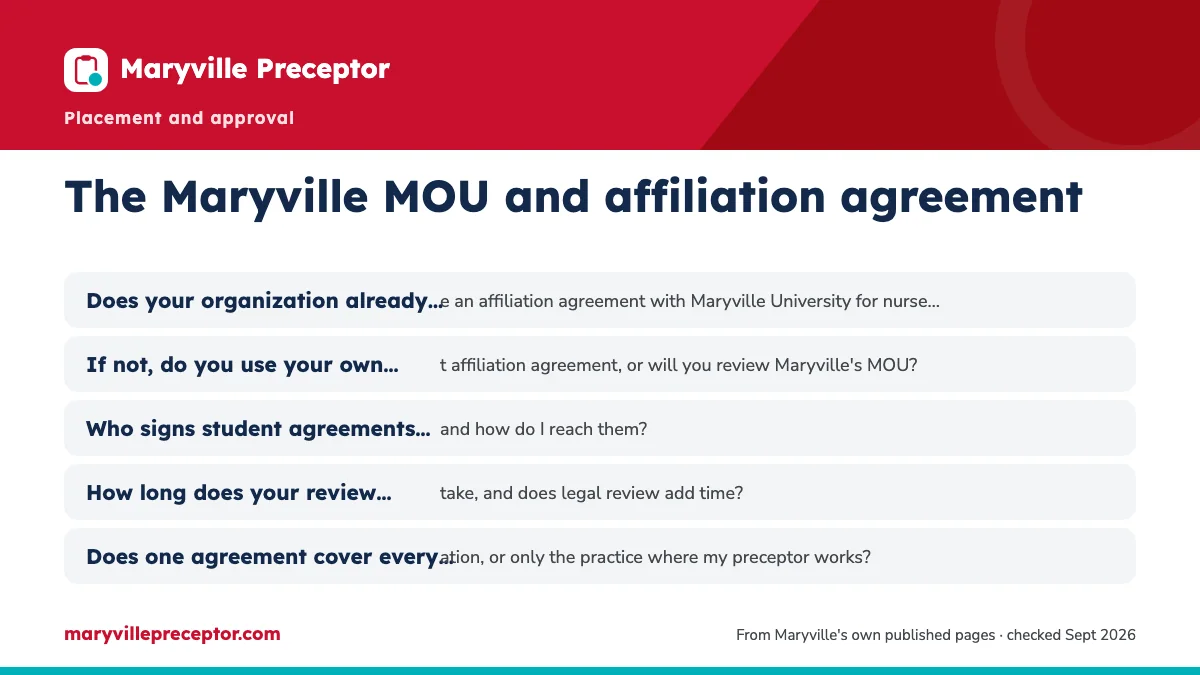
- Does your organization already have an affiliation agreement with Maryville University for nurse practitioner students?
- If not, do you use your own student affiliation agreement, or will you review Maryville's MOU?
- Who signs student agreements here, and how do I reach them?
- How long does your review usually take, and does legal review add time?
- Does one agreement cover every location, or only the practice where my preceptor works?
- Is there a separate onboarding process for students once the agreement is signed?
Pass the answers to the Online Clinical Team with the site's exact legal name and address. If the site has onboarding of its own, the next stop is the onboarding request.
Where the contract fits among the approvals
Maryville's March 2025 approvals article lists four sign-offs before clinical: cleared compliance, Maryville's Exxat decision on your site and preceptor, the site's own go-ahead, and course faculty sign-off. The contract isn't named as its own approval, and Maryville's current articles don't say where it is tracked in Exxat. Ask the Online Clinical Team whether your site already has an agreement on file before you submit the request.
Once you're placed, the contract is also why your own compliance matters. The June 2026 article calls attendance while non-compliant a breach of the site contract that could end in dismissal, and says a lapsed Exxat account puts the placement on hold. The contract's terms reach you, not just the two institutions. Keeping every item current is covered on clinical compliance.
What Maryville doesn't publish
The public record on contracts is thin. Maryville's pages don't say:
- who signs for Maryville, or how a signed agreement comes back;
- how long a new agreement usually takes;
- whether an agreement expires or needs renewing between terms;
- whether one agreement covers other Maryville students or other locations of the same organization;
- where the contract is tracked in Exxat, since the only public article describing it is from 2021.
The 2026 Maryville blog describes an online resource center, updated each semester, with timelines for required paperwork and contacts. That is where current answers are most likely to be: the Graduate Nursing Clinical Resource Center. For anything it doesn't cover, email the Online Clinical Team with the site's name, address and contract contact.
Common snags and how to head them off
Contract delays often come down to people rather than clauses. The clinician who agrees to precept you is rarely the person who signs contracts, and the signer may not know a request is coming. Introduce them early, and ask your preceptor to mention it internally.
Legal review is the other slow point. If the site uses its own contract and wants changes reviewed, that exchange happens between institutions, and your start date isn't their deadline. Build in time, and tell the Online Clinical Team your course dates when you pass on the site's contact.
A site that won't sign anything is a site you can't use, however good the preceptor. Learning that in the first week of your search is far better than learning it after Exxat access opens, which is why the contract question belongs in your first conversation with any site.
Why students bring us the contract question early
Contracts are where good placements quietly stall, so we treat the agreement as part of the search rather than an afterthought. Before we bring you a site, a placement advisor has already asked whether it works with Maryville, whether it uses the MOU or its own agreement, and who signs. You get those contacts in writing, so the Online Clinical Team reaches the right person on day one. We also weigh each site's usual review time against your course start, and when a new agreement looks too slow for your term, we move straight on to the next site.
The agreement is signed between Maryville and the site; we make sure the people who sign it hear about your placement early and have what they need to act. Tell us about your site or your search.
Questions Maryville students ask
Is an affiliation agreement the same as a preceptor agreement?
Not in Maryville's published material. The MOU or affiliation agreement is between Maryville and the clinical site. No public Maryville source names a separate preceptor agreement form; if one exists, it is most likely in the login-only Resource Center. Check there and in your Canvas course before you ask your preceptor to sign anything.
Who sends the MOU to my clinical site?
Maryville's 2021 article says the MOU is provided in the Graduate Nursing Clinical Resource Center and that students may need to check with the site's HR, business or education office on how agreements are handled. It doesn't spell out whether you or Maryville sends it. Read the current Resource Center instructions, and if they're unclear, ask the Online Clinical Team before you forward anything.
Does my employer need an affiliation agreement if I train there?
Maryville's published contract guidance doesn't carve out employers, so plan on your workplace needing Maryville's MOU or its own agreement like any other site. A 2023 webinar adds that you can't be on the clock during clinical time and the placement can't create a conflict of interest with your current role.
How long does an affiliation agreement take?
Maryville doesn't publish a timeline. It depends on whether the site already has an agreement with Maryville, whether it uses its own contract, and how long its legal or education office takes to review. Ask the site for its usual review time on the first call, and treat a site with no existing agreement as a likely slow step.
Does a signed MOU mean my placement is approved?
No. The contract clears the way between the institutions, but your placement still needs all four approvals: an approved compliance record, Maryville's Exxat approval of the request, the site's own clearance, and course faculty sign-off. A signed agreement doesn't help if the preceptor doesn't qualify or your compliance has lapsed.
Related pages
Last checked 2026-09-23
We check these pages against Maryville's own sources. Maryville's current guides and your course faculty have the final word.
- Ask Maryville: What is the Clinical Contract? (2021)
- Ask Maryville: What approvals do I need before I start my clinical for graduate nursing?
- Ask Maryville: Attending clinicals with missing requirements or Exxat locked (June 2026)
- Ask Maryville: How can I get information on the clinical process? (Graduate Nursing)
Hand us the search. Keep your start date.
Tell us your Maryville track, your county and your next start. We look for a preceptor and a site that fit what Maryville approves, and help you get the Exxat request right.
- Matched to your track's population and setting
- Checked against Maryville's preceptor rules before you submit
- In person near you, or a virtual option where your course allows it
Start your placement plan
A placement advisor replies with what a Maryville-ready preceptor and site look like for you.